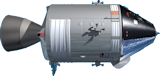
Flight of APOLLO11
I tried to collect the flight informations of Apollo11 in time series.
GET: Ground Elapsed Time
DateEVENTDESCRIPTION
Flight hardware began arriving at KSC
Mated CSM,LM,SLA was moved to VAB
Moved to LC39 PAD A from VAB It takes about 6 hour from VAB to LC39. Mobile Launcher No.1 was used for APOLLO11.
GETEVENTDESCRIPTION
Precount period start
Official countdown start Jul.14.1969 17:30:00
Install launch vehicle flight batteries (to T-23:30:00)
LM Stowage and cabin closeout (to T-15:00:00)
Top off LM super critical helium (to T-19:00:00)
Launch vehicle range safety checks (to T-15:00:00)
Install launch vehicle destruct devices
Command/Service module pre-ingress operations
(to T-10:45:00)
Start mobile service structure move to park site
Start six hour built-in-hold 11 hour 32 minutes hold was actually carried out.
Clear blast area for propellant loading
Astronaut backup crew to spacecraft for prelaunch checks
Start loading propellant thee stages (to T-03:38:00)
Flight crew alerted
Flight crew medical examination
Flight crew breakfast
Flight crew don space suit
T-03:07:00 Flight crew depart Manned Spacecraft Operations Building for LC39
Built-in countdown hold 30 minutes hold was carried out.
Flight crew arrive at LC39
Start flight crew ingress
Mission Control Center-Houston/Spacecraft command checks
Abort advisory system checks
Space vehicle Emergency Detection System (EDS) test
Retrack Apollo access arm to standby position (12 degrees)
Arm launch escape system
Final launch vehicle range safety checks (to T-00:35:00)
Launch vehicle power transfer test
LM switch over to internal power
Shutdown LM operational instrumentation (to T-00:10:00)
Spacecraft to internal power
Space vehicle final status checks
Arm destruct system
Apollo access arm fully retracted
Initiate firing command (automatic sequencer)
Launch vehicle transfer to internal power
Ignition sequence start
All engines running
GETAltitudeVelocityEVENTDESCRIPTION
182.7ft 0ft/sec
0km/h
Range Zero Timer start.
00:00:00.6 182.7ft 0ft/sec
0km/h
Lift Off Signal (TB-1) Jul.16.1969 09:32:00.6 EDT(Eastern Daylight Time)
Pitch and Roll start
Roll Complete
145600ft
44378m
6504.5ft/sec
7137.2km/h
S-IC Center Engine Cutoff (CECO)(TB-2)
Begin Tilt Arrest
217655ft
66341m
9030.6ft/sec
9909.1km/h
S-IC Outbord Engine Cutoff (OECO)(TB-3)
00:02:42.3 219984ft
67051m
9064.5ft/sec
9946.3km/h
S-IC/S-II Separation Vehicle reached at 50.6nm downrange.
221881ft
67629m
9059.1ft/sec
9940.4km/h
S-II Ignition (Engine start command)
301266ft
91826m
9469.0ft/sec
10390.1km/h
S-II Second Plane Separation S-II Aft. Interstage jettison.
315001ft
96012m
9777.6ft/sec
10728.8km/h
Launch Escape Tower Jettison
588152ft
179269m
18761.7ft/sec
20586.8km/h
S-II Center Engine Cutoff
S-IC falls into Atlantic Ocean At about 340nm downrange (30.3 degrees North latitude 73.5 degrees West longitude)
609759ft
185855m
22746.8ft/sec
24959.6km/h
S-II Outbord Engine Cutoff (TB-4)
00:09:08.2 609982ft
185923m
22756.7ft/sec
24970.5km/h
S-II/S-IVB Separation At about 885nm downrange.
610014ft
185932m
22756.7ft/sec
24970.5km/h
S-IVB Ignition (Engine start command) 1st burn.
617957ft
188353m
25562.4ft/sec
28049.1km/h
S-IVB Cutoff (TB-5)
00:11:49.3 617735ft
188286m
25567.9ft/sec
28055.1km/h
Earth Parking Orbit Insertion At about 4818nm downrange.
Stay at EPO for one and harf revolution (two and harf hour). Checking spacecraft systems and prepare for TLI.
S-II plunges into Atlantic Ocean At about 2300nm downrange (31 degrees North latitude 33.6 degrees West longitude)
02:34:38.2 Begin S-IVB Restert Preparations (TB-6) TLI start
"Go for TLI" message came from Carnarvon Manned Space Flight Network station.
Jul.16.1969 12:06:38.2 EDT
650558ft
198290m
25554.0ft/sec
28039.9km/h
Second S-IVB Ignition
1058809ft
322725m
35562.9ft/sec
39022.5km/h
Second S-IVB Cutoff (TB-7)
1103215ft
336260m
35538.5ft/sec
38995.7km/h
Translunar Injection (TLI) This maneuver was targeted for about 6fps overspeed. This was conpensated by Spacecraft Evasive Maneuver later.
CSM/S-IVB Separation, SLA Panel Jettison Start TD&E(Transposition,Docking and Ejection) operation. CSM leaves from SLA/S-IVB about 1fps, then 180 degree pitch maneuver. And 4 panels of SLA opend, LM comes to the sight.
CSM/LM Docking Complete CSM docks LM with S-IVB.
Spacecraft Ejection from S-IVB
Spacecraft Evasive Maneuver By this, CSM's speed down about 19.7fps. And S-IVB leads to the moon and crashes in. But, S-IVB of APOLLO11 didn't reach the moon, and it was thrown in solar orbit.
S-IVB Slingshot Maneuver Residual propellants dumped through the J2 engine. Not perofrmed at APOLLO11 mission.
Midcourse Correction-1 (MCC-1) (TLI+9)
Midcourse Correction-2 (MCC-2) (TLI+24)
Midcourse Correction-3 (MCC-3) (LOI-22)
Midcourse Correction-4 (MCC-4) (LOI-5)
75:49:49.6 80nm above the Moon Luner Orbit Insertion 1 Ignition (LOI-1) At the behind of the moon, 80nm above, at pericynthion, this burn made retrograde velocity change of about 2924fps. CSM/LM was inserted at elliptical orbit of apolune 170nm, periune 60nm.
Jul.19.1969 13:21:49.6 EDT
80nm above the Moon Luner Orbit Insertion 2 Ignition (LOI-2) After two revolution, at pericynthion, this burn made retrograde about 157.8fps. CSM/LM was inserted at circular orbit of apolune 65nm, periune 54nm. After this, LM pilot enter LM and make a brief checkout then return to CM.
LM Undocking from CSM This was done after 13 revolution. At that time, CSM orbit become 60nm circular. LM undocked from CSM about 0.5fps. LM went 40 feet from CSM and rotate, then CSM pilot checked development conditions of landing gear.
CSM Separation Maneuver Radially downward 2.5fps burn makes LM leave after CSM.
LM Descent Orbit Insertion (DOI) After harf revolution of undocking, at far side of the moon, after 2.2nm from CSM, LM does 74.2fps retrograde fire. Then LM entered Descent transfer orbit which pericynthion was 50,000feet.
LM Landing rader ON
50,000 feet LM Altitude of 50,000 feet
LM Powerd Descent Insertion (PDI) At abouut 260nm prior to touchdown, this PDI was performed. At start of PDI, LM windows faced to the moon and DPS nozzle headed to flight direction.
34ft/sec LM Face-up yaw maneuver in process LM yawed and windows up when reached 45,000feet. Landing radar was locked-on at about 39,000feet. It feed altitude data to guidance computer.
36ft/sec LM Face-up maneuver complete
35ft/sec LM 1202 alarm(computer determined)
35ft/sec LM Enable radar updates Radar altitude updates of the onboard computer were enabled. The altitude difference between that calculated by the onboard computer and that determined by the landing radar was approximately 2800 feet.
33ft/sec LM 1202 alarm(computer determined)
31ft/sec LM Throttle recovery The reduction in throttle was occurred at 386 seconds after ignition.
7129feet 15ft/sec LM Enter program P64 At 7129 feet, arrival at high gate (end of braking phase) and the automatic switch to final approach phase program P64.
5000feet 12ft/sec LM Attitude-hold At about 5000feet, the Commander switched his control mode from automatic to attitude-hold to check manual control in anticiaption of the final descent.
2500ft 8ft/sec LM 1201 alarm(computer determined)
4ft/sec LM 1202 alarm(computer determined)
2ft/sec LM Enter program P66 Enter manual landing phase. Landing phase starts at 500feet was called "low gate". Final vertical descent starts at about 150feet when horizontal movement becomes to zero. At that time, vertical speed was about 3fps.
102:45:43 0feet 0ft/sec Lunar Landing LM "Eagle" was landed at "Mare Tranquillitatis" 0:42:50 north latitude, 23:42:28 of east longitude. This is the place called 'SITE-2' which one of three landing candidate points left to the end.
Jul.20.1969 16:17:43 EDT
CSM Plane Change Maneuver CSM intended to do 0.18 degree orbit change at 2.25 revolution after LM touch down.
Crew Egress for Lunar Surface Operations
109:24:15 Armstrong On Lunar Surface When he got off to the surface of the moon, samples for the emergency are collected first, and it is stored in the pocket of the spacesuit. Then he opened and installed a S band antenna on the moon like an umbrella.
Jul.20.1969 22:56:15 EDT
Aldrin On Lunar Surface After setting TV camera and the Stars and Stripes, they begun picking of samples. Two sample return container (SRC) was filled with 130pounds of moon rocks and core tubes. Then they set Solar Wind Composition(SWC), Passive Seismic Experiment(PSE), Laser Ranging Retro Reflector(LRRR).
Aldrin Inside LM
Armstrong Inside LM:Hatch Closed
LM Liftoff Ascent stage burn time was 7min 14sec. 6,055fps posigrade velocity change. LM lifted vertically at altitude 250feet, speed 50fps, then started 'pictch over' to enter 9nm x 45nm lunar orbit. LM entered the orbit at 166nm west downrange.
Coelliptic (Concentric) Sequence Initiate Maneuver (CSI) By this maneuver and after CDH, LM entered 44.2nm x 45.5nm orbit, 15nm below CSM.
LM Plane Change Maneuver This is maneuver for adjust a position with CSM. Not performed at APOLLO11 mission.
Constant Differential Height Maneuver (CDH)
Terminal Phase Initiate Maneuver (TPI) LM entered 43.2nm x 61.2nm orbir. The orbit of CSM and LM crosses after about one half revolution.
Terminal Phase Finalize Maneuver (TPF) Two orbit adjustment was planed before docking. And at last, this braking maneuver was performed.
128:03:-- CSM/LM Docking
LM Jettison
CSM Separation Maneuver To avoid a collision with LM, about 1fps retrograde maneuver was done.
135:23:42 TransEarth Injection (TEI) At the far side of the moon, SPS engine burned 2min 29sec to leave from moon orbit. This made 3,293fps posigrade velocity change.
Jul.22.1969 00:55:42 EDT
Midcourse Correction-5 (MCC-5) at TEI+15 hour
Midcourse Correction-6 (MCC-6) at EI-15 hour
Midcourse Correction-7 (MCC-7) at EI-3 hour
194:49:19 CM/SM Separation Jul.24.1969 12:21:19 EDT
400,000ft
121920m
36194ft/sec
39715km/h
Entry Interface (EI) Start re-entry Earth atmosphere
From about 400,000ft, spacecraft began a slowdown by the influence of atmosphere at 171.4 degree east longitude, 3.5 degree south latitude. It takes the acceleration of the maximum 6.35G during the slowdown.
195:18:35 Splash Down A parachute begins to open from about 23,000 feet altitude, then splash down in about 1285nm east of the EI start point, that's speed was about 31fps . The position was 172.4 degree west longitude, 10.6 degree north latitude, the southwest of Hawaii.
Jul.24.1969 12:50:35 EDT


Launch of Apollo 11(by YouTube)


[DVD] Apollo 11 - Men on the Moon
Twentieth Century Fox Home Video (August 19, 2003) USD44.98
Mankind's greatest adventure is remembered for the digital age. The DVD format changed the way we look at movies and especially TV series, with massive complete-season sets. That concept is spectacularly taken one-step further with Spacecraft Films' definitive collections of the Gemini and Apollo space missions, stuffing in nearly every scrap of TV transmissions and on-board footage. The three- to six-disc sets use the full functions of the DVD format; see a liftoff in six different angles (some remixed with 5.1 sound) or listen to a mixture of air-to-ground communications, official NASA narration, or post-flight debriefings, most often carefully synched to the exact moment of footage seen. Like any good research paper, every bit of footage may not be interesting, but taken as a chronicle of history, it's irreplaceable.
View details(Amazon.com)

[BOOK] Apollo 11: The NASA Mission Reports
Humankind's first lunar landing is narrated by rare official documentation, collected for the first time in this volume.

Vol.1

Vol.2

Vol.3

[DVD] From the Earth to the Moon - The Signature Edition
Warner Home Video (September 20, 2005) USD70.98
Originally broadcast in April and May of 1998, the epic miniseries From the Earth to the Moon was HBO's most expensive production to date, with a budget of $68 million. Hosted by executive producer Tom Hanks, the miniseries tackles the daunting challenge of chronicling the entire history of NASA's Apollo space program from 1961 to 1972. For the most part, it's a rousing success. Some passages are flatly chronological, awkwardly wedging an abundance of factual detail into a routine dramatic structure. But each episode is devoted to a crucial aspect of the Apollo program. The cumulative effect is a deep and thorough appreciation of NASA's monumental achievement. With the help of a superlative cast, consistent writing, and a stable of talented directors, Hanks has shared his infectious enthusiasm for space exploration and the inspiring power of conquering the final frontier. NASA's complete participation in the production lends to its total authenticity, right down to the use of NASA equipment, launch locations, and even spacecraft. The re-creation of the lunar landscape is almost as impressive as the real thing and is further enhanced by the use of helium balloons to lighten the actors playing moon-walking astronauts. (These and other backstage details are revealed in the "making of" featurette, along with a wealth of supplemental materials, on a bonus disc in the miniseries' DVD package.) With a fictional, Walter Cronkite-like TV reporter (Lane Smith) serving as the dramatic link for all 12 episodes, this ambitious production may not be a great work of art. But as a generous and definitive example of nonfiction drama, it's full of the same kind of awe, inspiration, and humanity that led to "one giant leap" in the all-too-short history of 20th-century space exploration.
View details(Amazon.com)

[DVD] Apollo 13
Universal Studios (March 29, 2005) USD14.99
NASA's worst nightmare turned into one of the space agency's most heroic moments in 1970, when the Apollo 13 crew was forced to hobble home in a disabled capsule after an explosion seriously damaged the moon-bound spacecraft. Tom Hanks, Kevin Bacon, and Bill Paxton play (respectively) astronauts Jim Lovell, Jack Swigert, and Fred Haise in director Ron Howard's intense, painstakingly authentic docudrama. The Apollo 13 crew and Houston-based mission controllers race against time and heavy odds to return the damaged spacecraft safely to Earth from a distance of 205,500 miles. Using state-of-the-art special effects and ingenious filmmaking techniques, Howard and his stellar cast and crew build nail-biting tension while maintaining close fidelity to the facts. The result is a fitting tribute to the Apollo 13 mission and one of the biggest box-office hits of 1995.
View details(Amazon.com)

[BOOK] A Man on the Moon
Penguin (Non-Classics) (April 1, 1998) USD10.85
A decade in the making, this book is based on hundreds of hours of in-depth interviews with each of the twenty-four moon voyagers, as well as those who contributed their brain power, training and teamwork on Earth. In his preface Chaikin writes, "We touched the face of another world and became a people without limits." What follows are thrilling accounts of such remarkable experiences as the rush of a liftoff, the heart-stopping touchdown on the moon, the final hurdle of re-entry, competition for a seat on a moon flight, the tragic spacecraft fire, and the search for clues to the origin of the solar system on the slopes of lunar mountains. "I've been there. Chaikin took me back."--Gene Cernan, Apollo 17 astronaut--This text refers to an out of print or unavailable edition of this title.
View details(Amazon.com)

[BOOK] Apollo 13: Anniversary Edition
Houghton Mifflin (April 11, 2000) USD16.38
On April 13, 1970, three American astronauts were on their way to the moon when a mysterious explosion rocked their ship, forcing them to abandon the main ship and spend four days in the tiny lunar module which was intended to support two men for two days. A harrowing story of danger, courage and brilliant off-the-cuff engineering solutions which resulted in a dramatic rescue.
View details(Amazon.com)
Please look "Apollo Books & Videos" page for more books and videos related APOLLO.
Apollo Books & Videos


To Apollo Maniacs TOP